Brief anecdote: several years ago when I was still using online sites to get feedback on my writing one of the people reviewing a script of mine congratulated me for hitting the first pinch point on exactly the right page. He then proceeded to take me to task for not getting all the other points on the right pages.
One of the things I could have pointed out to him at the time was that due to my funky formatting, what he was taking as page 27 was probably closer to being page 25, so I missed the initial pinch point too. I didn't bother to mention it though.
A recent thread on Wordplay has been concerned over a different screenwriting term - whether there's a need to have a character arc in every story. I'd like to question whether there's a need to use the term 'character arc' at all, let alone have one.
There's a lot of terminology that gets thrown about regarding screenwriting especially, other writing not so much. Much of it seems to derive from self-help books that are more often written by screenwriting analysts rather than successful screenwriters.
As a result I'd put much of it on the Helpful to Writers Scale at somewhere around 3/10. Character arcs, plot points, pinch points, or whatever new terms the latest writing guru has created to sell his/her book are all useful if applied AFTER the screenplay has been finished and taken with a pinch of salt when doing so.
And that's only if you know you have a problem with the story but can't quite put your finger on what's wrong. Although frankly if that's the case then I'd suggest ditching the script and starting on your next one because you probably either need distance or more experience to solve the problem.
Where all these wonderful terms should be ignored (I'd say must, but that starts to sound like I'm inventing rules instead) is in actually writing the story. It's certainly important to understand how to pace a story, how to create compelling characters and so on - but slavishly ensuring that you tick off every single box in the Screenwriter's Workbook is not going to guarantee anything more than the appreciation of the other terminology slaves.
Tuesday, 13 January 2009


Saturday, 13 September 2008
Paragraphs
Finished the grammar/spelling/typos readthrough of the novel. I've moved onto going through and adjusting the paragraphs. This is a hold-over from my screenwriting where one of the general rules of thumb is to have no block of text that's more than four lines long.
I've noticed I have a habit when I'm originally drafting my novel of using long paragraphs. Actually I have a habit of using no paragraphs originally, as I'm writing longhand in a notebook and trying to cram as many words onto as few pages as I can - otherwise I'd be using dozens of notebooks rather than the two I managed to fit my novel into.
When I typed up my novel though, I do put in the paragraphs. Not as many as I should though, which is why the second run-through. One nice thing about this go through is that I don't have to dwell on every word, like my first edit/rewrite. Paragraph lengths is all about making the story easy to read - too long a block of text and the eye becomes lost in it. I also try to keep sentences short for similar reasons - that's taken care of by my reading-out-loud run-through.
So, if I scan the page and notice some of the paragraphs looking a bit bulky, I take a closer look to see what I can rearrange. Sometimes there's nothing that can be done - the paragraph is a series of consecutive thoughts that can't be broken up (except maybe be completely rewriting it - which I have done when it suits).
Most of the time though, there's a natural break. Sometimes it's when a character starts another action. Sometimes it's just about changing the emphasis slightly.
What I have noticed is that I'm fighting against this notion I have that paragraphs are supposed to be a sizable length - a certain number of sentences (for some reason four always springs to mind). What you notice if you look at a number of novels (modern novels - don't even think about trying to emulate the size of Dickens' paragraphs) is that a lot of paragraphs are no more than one or two sentences long.
Which is what I've been trying to do with this post.
It may seem like sweating over the details, but guiding the way the reader experiences the tale is the storyteller's key role. And the size of my paragraphs are one of the ways I try to do that.
I've noticed I have a habit when I'm originally drafting my novel of using long paragraphs. Actually I have a habit of using no paragraphs originally, as I'm writing longhand in a notebook and trying to cram as many words onto as few pages as I can - otherwise I'd be using dozens of notebooks rather than the two I managed to fit my novel into.
When I typed up my novel though, I do put in the paragraphs. Not as many as I should though, which is why the second run-through. One nice thing about this go through is that I don't have to dwell on every word, like my first edit/rewrite. Paragraph lengths is all about making the story easy to read - too long a block of text and the eye becomes lost in it. I also try to keep sentences short for similar reasons - that's taken care of by my reading-out-loud run-through.
So, if I scan the page and notice some of the paragraphs looking a bit bulky, I take a closer look to see what I can rearrange. Sometimes there's nothing that can be done - the paragraph is a series of consecutive thoughts that can't be broken up (except maybe be completely rewriting it - which I have done when it suits).
Most of the time though, there's a natural break. Sometimes it's when a character starts another action. Sometimes it's just about changing the emphasis slightly.
What I have noticed is that I'm fighting against this notion I have that paragraphs are supposed to be a sizable length - a certain number of sentences (for some reason four always springs to mind). What you notice if you look at a number of novels (modern novels - don't even think about trying to emulate the size of Dickens' paragraphs) is that a lot of paragraphs are no more than one or two sentences long.
Which is what I've been trying to do with this post.
It may seem like sweating over the details, but guiding the way the reader experiences the tale is the storyteller's key role. And the size of my paragraphs are one of the ways I try to do that.
Friday, 29 August 2008
Narrative Prose
I don't know what exactly is doing it, but my computer's becoming increasingly slow. It's probably something to do with my anti-virus software, or something in one of the Windows security patches, but my technical ability has been far outstripped by progress in computing (or is it regression as I'm sure all the new 'advances' are actually designed to make things worse than they were before).
Anyway, while I wait for my computer to do whatever it is that it's supposed to be doing, I tend to turn a book off one of the shelves behind me (I have three bookcases in the little room that I've turned into a writing room, nine shelves of which (and a bit of floor space) have been given over to my meager reference collection).
As I'm in the process of rewriting, I thought today that I'd pick up John Braine's Writing a Novel and flick through it in search of some words of wisdom. I used to read quite a few of the self-help writing books - less these days after I started realising that many of them were trying to teach me things that I know are wrong - or at least wrong for me.
The chapter I stopped at and grabbed a few sentences from has the same name as the title of this post - Narrative Prose. The first sentence reads:
Since I've started working on the current draft of my novel (third if anyone cares to know), I've been proceeding by reading every line aloud. This serves two purposes. Firstly, it forces me to dwell on every single word, whereas if I read it silently (without moving my lips!), I'd probably be skipping over words and allowing my brain to fill in some of the gaps - which is absolutely pointless if you're trying to proofread.
Secondly, and in keeping with Braine's rule, it allows me to check the rhythm of the sentences. If I can't speak it out loud, then it's likely that I've twisted my prose into some torturous shape that will probably obfuscate the meaning - or at the very least cause readers to stumble while they try to make sense of what I've written.
For the record I don't check these posts after I've written them, so expect all sorts of gnarly word constructions.
I also believe that there's something pleasing in reading prose that falls into the patterns of speech. As Braine points out slightly further down the page, behind every story there's a person (he uses the term man, but I'm much more PC than him!) telling the story. A short story, novella or novel is the written analogue of the narrated story - certainly if we take it back to how written language developed. And sometimes it's good to get back to the roots of the situation and remind ourselves just why we do things a certain way.
Anyway, while I wait for my computer to do whatever it is that it's supposed to be doing, I tend to turn a book off one of the shelves behind me (I have three bookcases in the little room that I've turned into a writing room, nine shelves of which (and a bit of floor space) have been given over to my meager reference collection).
As I'm in the process of rewriting, I thought today that I'd pick up John Braine's Writing a Novel and flick through it in search of some words of wisdom. I used to read quite a few of the self-help writing books - less these days after I started realising that many of them were trying to teach me things that I know are wrong - or at least wrong for me.
The chapter I stopped at and grabbed a few sentences from has the same name as the title of this post - Narrative Prose. The first sentence reads:
My working-rule with narrative prose is the same as for dialogue: if it can't be read aloud, it's no good.
Since I've started working on the current draft of my novel (third if anyone cares to know), I've been proceeding by reading every line aloud. This serves two purposes. Firstly, it forces me to dwell on every single word, whereas if I read it silently (without moving my lips!), I'd probably be skipping over words and allowing my brain to fill in some of the gaps - which is absolutely pointless if you're trying to proofread.
Secondly, and in keeping with Braine's rule, it allows me to check the rhythm of the sentences. If I can't speak it out loud, then it's likely that I've twisted my prose into some torturous shape that will probably obfuscate the meaning - or at the very least cause readers to stumble while they try to make sense of what I've written.
For the record I don't check these posts after I've written them, so expect all sorts of gnarly word constructions.
I also believe that there's something pleasing in reading prose that falls into the patterns of speech. As Braine points out slightly further down the page, behind every story there's a person (he uses the term man, but I'm much more PC than him!) telling the story. A short story, novella or novel is the written analogue of the narrated story - certainly if we take it back to how written language developed. And sometimes it's good to get back to the roots of the situation and remind ourselves just why we do things a certain way.
Sunday, 24 August 2008
Bad Dialogue
Here's a line I'm struggling with at the moment:
“I was. However I felt it would be a more efficient use of my time to turn it to our advantage in more than one way.”
Pretty awful, eh?
One of the problems with writing dialogue is that what works on the page doesn't necessarily work when read aloud. Not that I'm claiming the above example works well on the page either, but it's a problem with a lot of stuff that I've read. My first method of dealing with unwieldy dialogue is usually to reduce its word count - after all people don't follow the strict rules of grammar when talking and don't always use proper sentence structure, so paring back the dialogue can help make it sound more natural.
A particular issue I have with the above sentence is that the character speaking is non-human - a robot in fact - so there needs to be a degree of formality to the dialogue. However it doesn't read as formal - it reads as clunky. It's too long for a start - which is my next trick, cutting up the dialogue into several sentences.
Third solution I tend to fall back on quite a lot is cutting the sentence completely. Often when something reads wrong, I find it's superfluous to the story. However, if I ditch this one, I then have to rewrite, or excise, the following eight sentences, which seems like a bit much just because I'm struggling with finding a better way to rewrite that sentence.
Here's the quick and nasty rewrite version if I wasn't worrying about the formality of the sentence
“I was, but I thought I could could kill two birds with one stone.”
Not sure my robot is going to be using an idiom like that. So what I need is something that conveys the same concept with the same sort of brevity, but which uses plain English.
"I was, but I saw the opportunity to increase the benefit to us."
It's not going to win any prizes for great dialogue, but at least it reads faster, is a lot clearer and is not inconsistent with the voice of the character.
“I was. However I felt it would be a more efficient use of my time to turn it to our advantage in more than one way.”
Pretty awful, eh?
One of the problems with writing dialogue is that what works on the page doesn't necessarily work when read aloud. Not that I'm claiming the above example works well on the page either, but it's a problem with a lot of stuff that I've read. My first method of dealing with unwieldy dialogue is usually to reduce its word count - after all people don't follow the strict rules of grammar when talking and don't always use proper sentence structure, so paring back the dialogue can help make it sound more natural.
A particular issue I have with the above sentence is that the character speaking is non-human - a robot in fact - so there needs to be a degree of formality to the dialogue. However it doesn't read as formal - it reads as clunky. It's too long for a start - which is my next trick, cutting up the dialogue into several sentences.
Third solution I tend to fall back on quite a lot is cutting the sentence completely. Often when something reads wrong, I find it's superfluous to the story. However, if I ditch this one, I then have to rewrite, or excise, the following eight sentences, which seems like a bit much just because I'm struggling with finding a better way to rewrite that sentence.
Here's the quick and nasty rewrite version if I wasn't worrying about the formality of the sentence
“I was, but I thought I could could kill two birds with one stone.”
Not sure my robot is going to be using an idiom like that. So what I need is something that conveys the same concept with the same sort of brevity, but which uses plain English.
"I was, but I saw the opportunity to increase the benefit to us."
It's not going to win any prizes for great dialogue, but at least it reads faster, is a lot clearer and is not inconsistent with the voice of the character.
Saturday, 23 August 2008
Editing Mood
Originally I'd intended this blog to be a place where I could stick a couple of short stories and point people at them, but as I haven't written anything new recently, I thought maybe I'd throw a few things down about what's going on with my writing. At least that way it might encourage me to work harder.
At present I'm just over halfway through rewriting a novel that I'm hoping to have published sometime in the next year. It has a potential home, although I'm not going into any details (or putting too much home in that) as there's every likelihood that something will go wrong - such as me not finishing my editing work!
I have to confess that I'm terrible at finishing anything - I have the desire to be a perfectionist, but not necessarily the drive. So I'll tinker with something for ages, but will often abandon it in an unfinished state because I don't feel up to the task of making it as good as I believe it can be. I'm bad enough when it comes to editing short stories; it's so much worse when I'm dealing with 100,000+ words.
What's made this even worse today is that the part of my novel that I've been revisiting is uncannily similar to something going on in my life at the moment. Which is particularly odd as I wrote that part of the story about six months ago. I'm not going into details as I've never believed in living my life for all on the Internet to read, but it makes it a bit harder to edit when I'm having to deal not only with making that section of the novel readable, but also with the emotions that it's stirring up.
The part of me that's always a writer says "Now if only I can get some of those feelings on the page."
The part of me that's not a writer wants to be able to walk away from it all and play Overlord on my Xbox.
At the moment, the call of the Xbox is winning.
At present I'm just over halfway through rewriting a novel that I'm hoping to have published sometime in the next year. It has a potential home, although I'm not going into any details (or putting too much home in that) as there's every likelihood that something will go wrong - such as me not finishing my editing work!
I have to confess that I'm terrible at finishing anything - I have the desire to be a perfectionist, but not necessarily the drive. So I'll tinker with something for ages, but will often abandon it in an unfinished state because I don't feel up to the task of making it as good as I believe it can be. I'm bad enough when it comes to editing short stories; it's so much worse when I'm dealing with 100,000+ words.
What's made this even worse today is that the part of my novel that I've been revisiting is uncannily similar to something going on in my life at the moment. Which is particularly odd as I wrote that part of the story about six months ago. I'm not going into details as I've never believed in living my life for all on the Internet to read, but it makes it a bit harder to edit when I'm having to deal not only with making that section of the novel readable, but also with the emotions that it's stirring up.
The part of me that's always a writer says "Now if only I can get some of those feelings on the page."
The part of me that's not a writer wants to be able to walk away from it all and play Overlord on my Xbox.
At the moment, the call of the Xbox is winning.
Monday, 30 June 2008
High Concept Visuals
As Bill Martell keeps mentioning my idea for what I called high concept visuals, I thought it might be of some use to post a bit about them. This was written with an audience of me in mind, as I was trying to figure it out for my own use, so if it's a little rough around the edges, that's why.
High Concept Visuals
As in High Concept ideas (HCIs), the notion of the High Concept Visual (HCV) is a visual idea that can be easily described, which will suggest in the reader’s mind a movie that must be seen.
HCVs include Bullet Time in THE MATRIX, the moonlight skeletonisation of the pirates in PIRATES OF THE CARIBBEAN and the time travel effects of the recent adaptation of THE TIME MACHINE.
Alone an HCV does not guarantee a good film. What it should guarantee are cinematic sequences in that film that haven’t been seen before.
As with HCIs, the HCV can be an amalgamation of previous visual systems and perhaps may be created by combining two visual systems that the audience is familiar with into a different form. THE TIME MACHINE uses time lapse photography as a basis for its HCV, but also adds a reverse zoom effect, which is seen with the sequence that starts on Earth in the past and ends up on the moon colony in the future.
The reverse zoom effect is also used in Men In Black as the end, starting with the Earth, moving out into the galaxy and then ending up with galaxy as a marble in an alien child’s hand. Although a very interesting visual, it is not an HCV, as the point of view is straight forward and consistent, even if the end is unexpected.
HCVs are not about using special effects to create something more realistically than has been done before, such as the dinosaurs in JURASSIC PARK, they are about creating written scenes that dictate a visual style that is not reliant on an effects breakthrough to provide novelty. Judging from the script alone, the dinosaurs in JURASSIC PARK could have conceivably been created using stop motion, animatronics, or animation had CGI effects not been used.
An HCV is not just about using a special effect in a different way either. The effect must be essential to the story and the characters or the environment. Trick photography (the bomb’s POV in PEARL HARBOR, the slow motion explosion in SWORDFISH) can make a shot more interesting, but if it is a staging decision rather than a story decision, it is not an HCV.
HCVs relate to several different concepts. Often an HCV includes several of these:
PERCEPTION provides a visual representation of the characters’ senses, or their thoughts.
In THE MATRIX the audience sees how Neo (Keanu Reeves) perceives the world of The Matrix, where the slow motion of bullet time isn’t just used for effect, but as Neo’s real-time perception of the world. The concept is expanded upon further when Neo’s abilities grow so that he can actually see the code of the Matrix when he’s inside.
In THE FISHER KING, the fantasy sequences show the audience what the world looks like through the eyes of Henry Sagan/Parry (Robin Williams) and provides insight into his delusions.
CSI provides a visual realisation of the character’s thoughts as they describe the possible results of their evidence, from reconstructions of how the crime might have happened, to illustrations of the physical effects of body trauma, such as a gunshot, from inside the body.
A BEAUTIFUL MIND uses a similar concept to the FISHER KING and CSI, where the thoughts of John Nash (Russell Crowe) are first shown to the audience as he works out various problems. This visualisation of his thought processes also throws out a subtle clue to his schizophrenic delusions, which are also shown on screen.
Other examples include GHOST and THE DEAD ZONE.
TRANSFORMATION can occur both to characters or to the environment. In some films, such as FREQUENCY, where transformations resulting from changes to the past create changes to both the characters and the environment, it happens to both.
Transformation itself is not enough to be considered an HCV, so there must be at least one other element at play. The Transformation in an action film, for example, usually has some effect on the outcome of the climax, often increasing the danger the protagonist is place in either from his own ill-timed transformations (VAN HELSING where Van Helsing (Hugh Jackman) keeps reverting from werewolf to human in his fight with Dracula (Richard Roxburgh) whenever the full moon is obscured), or through the untimely transformations of the antagonist(s).
In some cases transformation will be tied into the defeat of the antagonist (the defeat of Sebastian Caine (Kevin Bacon) in HOLLOW MAN once he has become partially visible).
Other examples include THE MASK and COOL WORLD.
Environmental transformation can be used to indicate a change caused by time or travel (THE TIME MACHINE), an unearthly environment (Heaven as a painting of an Earthly location in WHAT DREAMS MAY COME), or a manipulation of the environment (such as the water powers of the aliens in THE ABYSS).
JUXTAPOSITION creates unusual combinations of visual elements, either by directly linking them by placing them on the same screen (such as the black and white/colour mix of PLEASANTVILLE), or though intercutting between two different views of the same event, such as the inside-the-body, outside-the-body action sequences of INNERSPACE.
High Concept Visuals
As in High Concept ideas (HCIs), the notion of the High Concept Visual (HCV) is a visual idea that can be easily described, which will suggest in the reader’s mind a movie that must be seen.
HCVs include Bullet Time in THE MATRIX, the moonlight skeletonisation of the pirates in PIRATES OF THE CARIBBEAN and the time travel effects of the recent adaptation of THE TIME MACHINE.
Alone an HCV does not guarantee a good film. What it should guarantee are cinematic sequences in that film that haven’t been seen before.
As with HCIs, the HCV can be an amalgamation of previous visual systems and perhaps may be created by combining two visual systems that the audience is familiar with into a different form. THE TIME MACHINE uses time lapse photography as a basis for its HCV, but also adds a reverse zoom effect, which is seen with the sequence that starts on Earth in the past and ends up on the moon colony in the future.
The reverse zoom effect is also used in Men In Black as the end, starting with the Earth, moving out into the galaxy and then ending up with galaxy as a marble in an alien child’s hand. Although a very interesting visual, it is not an HCV, as the point of view is straight forward and consistent, even if the end is unexpected.
HCVs are not about using special effects to create something more realistically than has been done before, such as the dinosaurs in JURASSIC PARK, they are about creating written scenes that dictate a visual style that is not reliant on an effects breakthrough to provide novelty. Judging from the script alone, the dinosaurs in JURASSIC PARK could have conceivably been created using stop motion, animatronics, or animation had CGI effects not been used.
An HCV is not just about using a special effect in a different way either. The effect must be essential to the story and the characters or the environment. Trick photography (the bomb’s POV in PEARL HARBOR, the slow motion explosion in SWORDFISH) can make a shot more interesting, but if it is a staging decision rather than a story decision, it is not an HCV.
HCVs relate to several different concepts. Often an HCV includes several of these:
PERCEPTION provides a visual representation of the characters’ senses, or their thoughts.
In THE MATRIX the audience sees how Neo (Keanu Reeves) perceives the world of The Matrix, where the slow motion of bullet time isn’t just used for effect, but as Neo’s real-time perception of the world. The concept is expanded upon further when Neo’s abilities grow so that he can actually see the code of the Matrix when he’s inside.
In THE FISHER KING, the fantasy sequences show the audience what the world looks like through the eyes of Henry Sagan/Parry (Robin Williams) and provides insight into his delusions.
CSI provides a visual realisation of the character’s thoughts as they describe the possible results of their evidence, from reconstructions of how the crime might have happened, to illustrations of the physical effects of body trauma, such as a gunshot, from inside the body.
A BEAUTIFUL MIND uses a similar concept to the FISHER KING and CSI, where the thoughts of John Nash (Russell Crowe) are first shown to the audience as he works out various problems. This visualisation of his thought processes also throws out a subtle clue to his schizophrenic delusions, which are also shown on screen.
Other examples include GHOST and THE DEAD ZONE.
TRANSFORMATION can occur both to characters or to the environment. In some films, such as FREQUENCY, where transformations resulting from changes to the past create changes to both the characters and the environment, it happens to both.
Transformation itself is not enough to be considered an HCV, so there must be at least one other element at play. The Transformation in an action film, for example, usually has some effect on the outcome of the climax, often increasing the danger the protagonist is place in either from his own ill-timed transformations (VAN HELSING where Van Helsing (Hugh Jackman) keeps reverting from werewolf to human in his fight with Dracula (Richard Roxburgh) whenever the full moon is obscured), or through the untimely transformations of the antagonist(s).
In some cases transformation will be tied into the defeat of the antagonist (the defeat of Sebastian Caine (Kevin Bacon) in HOLLOW MAN once he has become partially visible).
Other examples include THE MASK and COOL WORLD.
Environmental transformation can be used to indicate a change caused by time or travel (THE TIME MACHINE), an unearthly environment (Heaven as a painting of an Earthly location in WHAT DREAMS MAY COME), or a manipulation of the environment (such as the water powers of the aliens in THE ABYSS).
JUXTAPOSITION creates unusual combinations of visual elements, either by directly linking them by placing them on the same screen (such as the black and white/colour mix of PLEASANTVILLE), or though intercutting between two different views of the same event, such as the inside-the-body, outside-the-body action sequences of INNERSPACE.
Sunday, 2 March 2008
Bridgetown
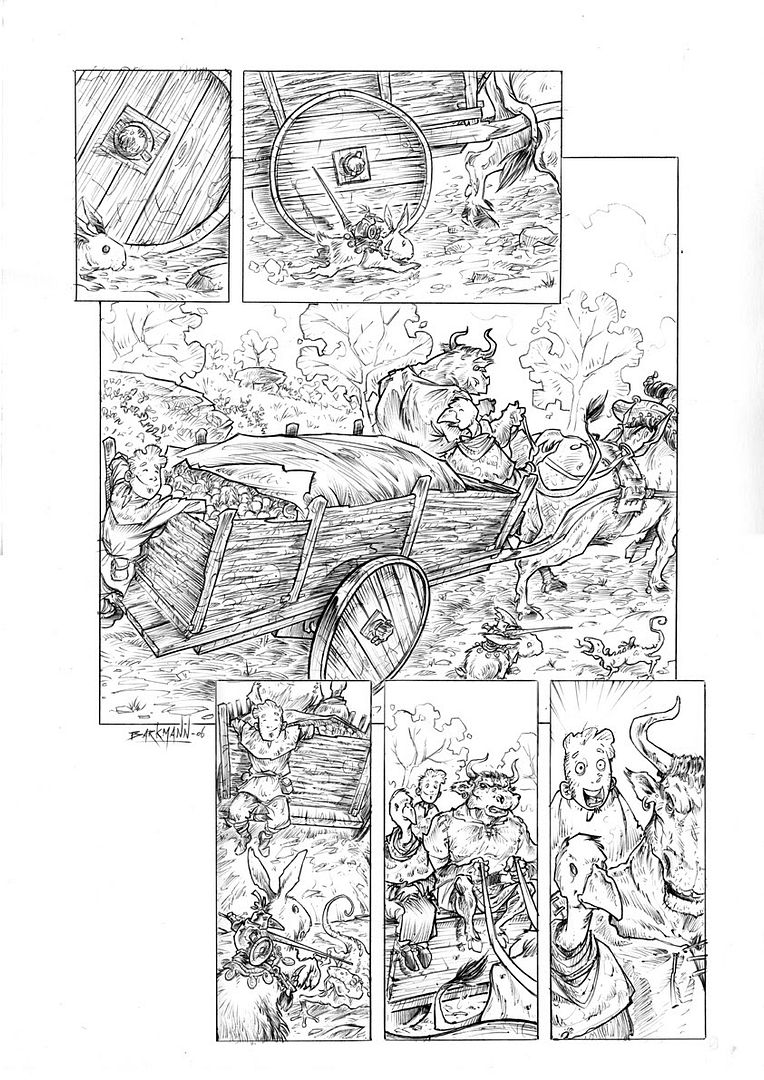
This is a script for a proposed comic book called 'Bridgetown' that sadly never saw the light of day. Although I do have a very nice first page for it drawn by David "Barkmann" Cerqueira.
PAGE 1
Panel 1
The lower part of a cart wheel takes up most of the panel as it travels along a rocky mountain road.
A rabbit peers over the bottom of the panel in the left hand corner..
THATCH (unseen but sitting at the rear of the cart): How much further is it?
Panel 2
Pull back from the previous panel’s view. Both of the cart wheels are now visible, along with the legs of the ox pulling it.
The rabbit in the foreground can now be seen in full. His back is covered with a tiny leather saddle, an armoured pixie, looking like a miniature St George, rides on top.
BULL (unseen but sitting at the front of the cart): Give it a rest, Thatch!
Panel 3
Side view of the cart (pulled back from previous picture). Sitting up on the front bench are BULL and GOOSE. They’re brothers, but there‘s no real family resemblance. Both look like the animals they’re named after. Bull has a thick neck, a punched-in face and looks as if he bench-presses cattle. Goose is thin with a long neck and a beaky nose.
The cart carries a load of turnips, mostly under cover, but one or two can be seen poking through.
On the backboard of the cart rides Bull and Goose’s younger brother, THATCH. A handsome lad with the healthy frame of a young man who’s grown up bailing hay, his blond unkempt hair makes his name appropriate.
Low on the ground the pixie-mounted rabbit faces off against a lizard.
In the background, fir trees.
GOOSE: You can’t blame him, Bull. His first time in Bridgetown after all.
Panel 4
Rear view of the cart. Thatch watches the pixie, now behind the cart, skewer the lizard with a miniature lance.
BULL: He doesn’t have to ask every mile.
GOOSE: How much further is it anyway?
Panel 5
Front view of the cart, looking over the ox’s back.
Thatch has turned his head to face front as he listens to his brothers.
BULL: Not much .
Panel 6
Same as previous, except this time Thatch’s eyes are open wide in wonder.
BULL: In fact, I think it‘s safe to say...

PAGE 2 AND 3
Full spread
The cart in the bottom right corner stands at the top of a steep hill that winds its way down the fir tree covered mountainside to two wide portcullis gates (both presently open), which in turn lead onto Bridgetown. Bridgetown runs from centre bottom to top left.
A giant bridge, it is covered in hundreds of buildings, including a castle in the centre. Nets, rope bridges and hand cranked elevators line the sides. There are even some houses fastened to the undersides of some of the bridge’s giant arches.
The architectural styles are predominantly European Middle Age on the nearest side, however there should also be influences of Oriental and Arabic architecture. The far side of the bridge has a stronger Oriental style to it - however, as the bridge is so long, it’s hard to make out.
A river runs out the left side of the bridge (the right is obscured as the bridge is so high), moving towards the upper right hand side of the picture.
BULL: ...we’re here.
PAGE 4
Panel 1
The cart passes through the left-hand portcullis gate. A guardsman stands sentry duty.
Thatch has turned so that he can see where they’re going.
Panel 2
Side view of the cart passing a tavern - “The Bridge‘s End”.
Panel 3
Three dancing girls, dressed in translucent silks, stand with their backs to us in the foreground of the panel. The cart passes in the background. Thatch watches them with his mouth agape.
Panel 4
The cart passes underneath an arched bridge into the market area - colourful tented stalls line the route. It has the look of an Arabian market.
PAGE 5
Panel 1
The brothers unload the turnips from their cart onto an empty stall.
Panel 2
The brothers stand behind the stall, looking bored. There’s no one else in sight.
THATCH: Does it get any busier than this?
Panel 3
A crowd surrounds the stall. Goose hands out a turnip over the heads of the people standing at the front of the stall.
GOOSE: Busy enough for you yet?
Panel 4
Just one customer now, holding the last of the turnips. The stall’s empty now.
Bull takes money from the customer.
PAGE 6
Panel 1
Bull counts the money into piles.
BULL: Right, that’s the last of it.
Panel 2
Bull drops a few coins onto Goose’s outstretched palm.
BULL: Half for you, half for Thatch. Okay?
GOOSE: Time to hit the bridge.
Panel 3
Goose drops a couple of coins onto Thatch’s outstretched palm. Thatch watches, screwing his face up with disappointment.
THATCH: Is this it?
Panel 4
Bull and Goose. Bull looks serious, Goose has a grin plastered across his face.
BULL: We need something left to show for our trouble. Dad would skin us alive if we spent it all.
GOOSE: You’ve got enough for a skinful of wine and a cheap tart.
PAGE 7
Panel 1
Bull and Goose stride off into the distance. Goose half turns his head to call behind him.
GOOSE: Come on little brother, keep up!
Panel 2
The milling Bridgetown crowds separate Thatch from his two brothers. He struggles to keep up, but there’s no way he’s going to find them in the crowd.
THATCH: Hey, wait for me.
Panel 3
Bull and Goose walk with the crowd at their backs, Bull checks over his shoulder.
GOOSE: We lost him yet?
BULL: Reckon so.
Panel 4
Goose slips Bull some coins.
GOOSE: Here’s your split of Thatch’s money then.
BULL: I couldn’t have kept a straight face.
GOOSE: You need practice to lie properly.
Panel 5
Bull and Goose walk off, arms around each other’s shoulders.
BULL: Now let’s go get pissed.
PAGE 8
Panel 1
Thatch walks down a narrow stairway in-between two buildings, descending into the darker parts of the town.
Behind him, at the top of the stairs, KAT, an attractive young thief, dressed in makeshift leather armour, runs in his direction.
THATCH: Bull! Goose! (small text) Could have sworn I saw...
Panel 2
Kat shoves Thatch out of her way.
Behind them at the top of the stairs, two gang members, BREVIS and FLEX chase after her. Both of them have bald heads. Both of them have a black handprint tattooed into their scalps as a symbol of their gang membership.
KAT: Coming through.
Panel 3
Brevis and Flex run past Thatch on the steps.
PAGE 9
Panel 1
In the street at the bottom of the stairs are another two bald, tattooed gang members, POL and NAIL. POL, steps out to intercept Kat.
The pair chasing her pass Thatch on the steps.
POL: Hold it, Kat. You owe us money!
Panel 2
Kat shrugs.
KAT: I don’t have it.
Panel 3
Pol pushes Kat onto the ground.
POL: Other ways we can get it out of you.
Panel 4
The four gang members surround Kat. Pol bends down to grab her arm.
POL: Lets see if there’s a girl under all that dirt.
PAGE 10
Panel 1
Thatch rolls his sleeves up, ready to protect the girl.
THATCH: Get your hands off her.
Panel 2
Thatch wades into the gang members, throwing an uppercut to Flex’s jaw.
Panel 3
In the foreground, Kat picks herself up. Flex lies on the floor behind her.
PAGE 11
Panel 1
Thatch punches Brevis in the nose. Nail raises up a cudgel.
Panel 2
Thatch grabs the cudgel in mid air.
Panel 3
Still holding the cudgel, Thatch pulls Nail closer and knees him in the stomach.
PAGE 12
Panel 1
Pol comes up behind Thatch. He holds a knife close to his waist, intending to stab Thatch in the kidneys.
Panel 2
Holding her hands together, Kat smacks them into Pol’s back. Thatch half turns, looking surprised.
Panel 3
Thatch grabs a cudgel from another, while punching a third in the gut. Kat smacks both her fists into Hans’ back.
Panel 4
Thatch and Kat stand over the fallen bodies of the gang members. Kat kicks the prone Pol in the side.
THATCH: Not very tough, these city lads.
DIRK: (off panel) Not very bright, these farm boys.
PAGE 13
Panel 1
A large panel - it should take up most of the page, leaving room for three fairly small panels along the bottom.
Thatch and Kat stand in between two clusters of gang members. Weapons are drawn - it looks nasty.
Dirk, the leader, stands with the group on the left. He has a dagger in his hand.
DIRK: Too stupid to know when they’ve fallen into a trap.
Panel 2
An arrow flying through the air
Panel 3
Dirk’s hand, the arrow through it. The knife drops from his grasp.
Panel 4
Dirk holds the hand with the arrow through of it in front of him. Still in shock, the pain hasn’t hit yet.
PAGE 14
Panel 1
Thatch and Kat stand in the centre of the panel. Surrounding them are Dirk’s band. Surrounding those are a new gang - the thieves.
Archers crouch on the top of walls, their arrows aimed at Dirk’s gang.
Panel 2
Kat reaches for Thatch’s hand.
KAT: Don’t just stand there.
Panel 3
Close up on their hands clasping together.
KAT: Let’s get out of here!
Panel 4
Still holding hands, Kat and Thatch run. The two gangs clash in the background, the tattooed gang clearly losing to the thieves.
PAGE 15
Panel 1
The fight no longer in view, Thatch and Kat stop for a moment. Thatch leans against a wall. Kat stands bent over, her hands resting on the top of her legs as she catches her breath.
THATCH: That was lucky.
KAT: Not so much. Spike was waiting for me there.
Panel 2
Close on Thatch’s face.
THATCH: It was a trap? Then you weren’t really in trouble?
Panel 3
Kat kisses Thatch’s cheek.
KAT: It was very gallant of you to come to my rescue.
Panel 3
Thatch scratches his head.
THATCH: Then I guess I...
PAGE 16
Panel 1
Kat grabs Thatch’s hand with both hers, pulling at him
KAT: Come on.
Panel 2
Just holding on with one hand now, Kat leads a confused-looking Thatch.
THATCH: Where are we going now?
Panel 3
Kat smiles at Thatch. a mischievous look to her eye.
KAT: You did me a turn. Thought I should return the favour.
PAGE 17
Panel 1
They pass underneath a stone arched bridge. On top of the bridge, a drunken Goose makes out with a painted tart who can’t be younger than fifty.
THATCH: How do you mean?
Panel 2
Midshot of Thatch and Kat, the bridge and Goose behind them.
KAT: Figure a country boy like you could do with the guided tour.
PAGE 18
Panel 1
Kat and Thatch cross a rope bridge. In the street beneath it, Bull is being sick in the gutter, much to the amusement of a group of drunken revellers.
KAT: Unless you weren’t done taking on the gangs of Bridgetown single-handed.
THATCH: I think I’m done for the night.
PAGE 19
Panel 1
Kat and Thatch approach the base of a tower. A primitive elevator, a cage attached to a chain winch, stands next to it. WINCH, a man with tree-trunk-thick limbs stands by the winch. He raises a hand in greeting to Kat.
KAT: Hey Winch!
WINCH: Still picking up strays Kat?
Panel 2
Winch peers forward to look at Thatch.
WINCH: At least this one doesn’t look like he’s got fleas.
Panel 3
Kat puts her arm around Thatch and squeezes close.
KAT: This is my very own knight in shining overalls.
Panel 4
Winch and Thatch shake hands.
WINCH: Going up?
Panel 5
Kat looks at Thatch, a hungry expression in her eyes.
KAT: I hope so.
PAGE 20
Panel 1
Kat steps into the cage. She holds out her hand to a hesitant Thatch.
KAT: Come on.
Panel 2
Thatch looks wary.
THATCH: Is it safe?
Panel 3
Kat grins, her hand still outstretched.
KAT: Where would the fun be if it was?
Panel 4
Thatch takes Kat’s hand.
PAGE 21
Full page
The cage halfway up the tower, Bridgetown laid out beneath it.
PAGE 22
Panel 1
The cage elevator at the top of the tower. Kat helps Thatch onto the roof.
KAT: What do you think of my town?
Panel 2
Wide across the page, Kat and Thatch looking across the town from on high. Thatch turns his head towards Kat.
THATCH: It’s beautiful. Just like...
Panel 3
Same as previous panel, this time with Kat pulling Thatch’s head towards her.
KAT: Just shut up and kiss me.
Panel 4
Same as previous panel, this time Kat and Thatch are having their movie happy ending kiss.
PAGE 23
Panel 1
Worse for wear, Bull and Goose stagger down the street, holding onto each other for support.
Bull stretches out his free arm to gesture, almost as if he’s telling a story about a fish that got away.
With his free hand, Goose cups his chest to indicate large breasts.
BULL: ...then after I’d drunken them all under the table...
GOOSE: ...should have seen the jugs on her, I’m telling you...
Panel 2
Thatch leans against the cart, waiting for them, a slightly dreamy look in his eyes.
THATCH: Hey guys.
Panel 3
Goose points at Thatch in drunken fashion.
GOOSE: Hey little brother. What you get up to?
Panel 4
Goose climbs up at the front of the cart. Bull climbs into the empty back, where all the turnips had been . Thatch sits at the back.
THATCH: Just a bit of sight-seeing.
BULL: You take it for the first bit. I’m going to lie down here for a while.
Panel 5
Side on view as the cart drives through the gate.
GOOSE: You can come up front with me for a bit, little bro.
THATCH: No, it’s okay, I’m good here for now.
PAGE 24
Full Page
Rear view of the cart, which has passed through the gate. Thatch raises a hand to wave at Kat, who crouches on top of the wall above the gate, watching the cart leave.
PAGE 1
Panel 1
The lower part of a cart wheel takes up most of the panel as it travels along a rocky mountain road.
A rabbit peers over the bottom of the panel in the left hand corner..
THATCH (unseen but sitting at the rear of the cart): How much further is it?
Panel 2
Pull back from the previous panel’s view. Both of the cart wheels are now visible, along with the legs of the ox pulling it.
The rabbit in the foreground can now be seen in full. His back is covered with a tiny leather saddle, an armoured pixie, looking like a miniature St George, rides on top.
BULL (unseen but sitting at the front of the cart): Give it a rest, Thatch!
Panel 3
Side view of the cart (pulled back from previous picture). Sitting up on the front bench are BULL and GOOSE. They’re brothers, but there‘s no real family resemblance. Both look like the animals they’re named after. Bull has a thick neck, a punched-in face and looks as if he bench-presses cattle. Goose is thin with a long neck and a beaky nose.
The cart carries a load of turnips, mostly under cover, but one or two can be seen poking through.
On the backboard of the cart rides Bull and Goose’s younger brother, THATCH. A handsome lad with the healthy frame of a young man who’s grown up bailing hay, his blond unkempt hair makes his name appropriate.
Low on the ground the pixie-mounted rabbit faces off against a lizard.
In the background, fir trees.
GOOSE: You can’t blame him, Bull. His first time in Bridgetown after all.
Panel 4
Rear view of the cart. Thatch watches the pixie, now behind the cart, skewer the lizard with a miniature lance.
BULL: He doesn’t have to ask every mile.
GOOSE: How much further is it anyway?
Panel 5
Front view of the cart, looking over the ox’s back.
Thatch has turned his head to face front as he listens to his brothers.
BULL: Not much .
Panel 6
Same as previous, except this time Thatch’s eyes are open wide in wonder.
BULL: In fact, I think it‘s safe to say...
PAGE 2 AND 3
Full spread
The cart in the bottom right corner stands at the top of a steep hill that winds its way down the fir tree covered mountainside to two wide portcullis gates (both presently open), which in turn lead onto Bridgetown. Bridgetown runs from centre bottom to top left.
A giant bridge, it is covered in hundreds of buildings, including a castle in the centre. Nets, rope bridges and hand cranked elevators line the sides. There are even some houses fastened to the undersides of some of the bridge’s giant arches.
The architectural styles are predominantly European Middle Age on the nearest side, however there should also be influences of Oriental and Arabic architecture. The far side of the bridge has a stronger Oriental style to it - however, as the bridge is so long, it’s hard to make out.
A river runs out the left side of the bridge (the right is obscured as the bridge is so high), moving towards the upper right hand side of the picture.
BULL: ...we’re here.
PAGE 4
Panel 1
The cart passes through the left-hand portcullis gate. A guardsman stands sentry duty.
Thatch has turned so that he can see where they’re going.
Panel 2
Side view of the cart passing a tavern - “The Bridge‘s End”.
Panel 3
Three dancing girls, dressed in translucent silks, stand with their backs to us in the foreground of the panel. The cart passes in the background. Thatch watches them with his mouth agape.
Panel 4
The cart passes underneath an arched bridge into the market area - colourful tented stalls line the route. It has the look of an Arabian market.
PAGE 5
Panel 1
The brothers unload the turnips from their cart onto an empty stall.
Panel 2
The brothers stand behind the stall, looking bored. There’s no one else in sight.
THATCH: Does it get any busier than this?
Panel 3
A crowd surrounds the stall. Goose hands out a turnip over the heads of the people standing at the front of the stall.
GOOSE: Busy enough for you yet?
Panel 4
Just one customer now, holding the last of the turnips. The stall’s empty now.
Bull takes money from the customer.
PAGE 6
Panel 1
Bull counts the money into piles.
BULL: Right, that’s the last of it.
Panel 2
Bull drops a few coins onto Goose’s outstretched palm.
BULL: Half for you, half for Thatch. Okay?
GOOSE: Time to hit the bridge.
Panel 3
Goose drops a couple of coins onto Thatch’s outstretched palm. Thatch watches, screwing his face up with disappointment.
THATCH: Is this it?
Panel 4
Bull and Goose. Bull looks serious, Goose has a grin plastered across his face.
BULL: We need something left to show for our trouble. Dad would skin us alive if we spent it all.
GOOSE: You’ve got enough for a skinful of wine and a cheap tart.
PAGE 7
Panel 1
Bull and Goose stride off into the distance. Goose half turns his head to call behind him.
GOOSE: Come on little brother, keep up!
Panel 2
The milling Bridgetown crowds separate Thatch from his two brothers. He struggles to keep up, but there’s no way he’s going to find them in the crowd.
THATCH: Hey, wait for me.
Panel 3
Bull and Goose walk with the crowd at their backs, Bull checks over his shoulder.
GOOSE: We lost him yet?
BULL: Reckon so.
Panel 4
Goose slips Bull some coins.
GOOSE: Here’s your split of Thatch’s money then.
BULL: I couldn’t have kept a straight face.
GOOSE: You need practice to lie properly.
Panel 5
Bull and Goose walk off, arms around each other’s shoulders.
BULL: Now let’s go get pissed.
PAGE 8
Panel 1
Thatch walks down a narrow stairway in-between two buildings, descending into the darker parts of the town.
Behind him, at the top of the stairs, KAT, an attractive young thief, dressed in makeshift leather armour, runs in his direction.
THATCH: Bull! Goose! (small text) Could have sworn I saw...
Panel 2
Kat shoves Thatch out of her way.
Behind them at the top of the stairs, two gang members, BREVIS and FLEX chase after her. Both of them have bald heads. Both of them have a black handprint tattooed into their scalps as a symbol of their gang membership.
KAT: Coming through.
Panel 3
Brevis and Flex run past Thatch on the steps.
PAGE 9
Panel 1
In the street at the bottom of the stairs are another two bald, tattooed gang members, POL and NAIL. POL, steps out to intercept Kat.
The pair chasing her pass Thatch on the steps.
POL: Hold it, Kat. You owe us money!
Panel 2
Kat shrugs.
KAT: I don’t have it.
Panel 3
Pol pushes Kat onto the ground.
POL: Other ways we can get it out of you.
Panel 4
The four gang members surround Kat. Pol bends down to grab her arm.
POL: Lets see if there’s a girl under all that dirt.
PAGE 10
Panel 1
Thatch rolls his sleeves up, ready to protect the girl.
THATCH: Get your hands off her.
Panel 2
Thatch wades into the gang members, throwing an uppercut to Flex’s jaw.
Panel 3
In the foreground, Kat picks herself up. Flex lies on the floor behind her.
PAGE 11
Panel 1
Thatch punches Brevis in the nose. Nail raises up a cudgel.
Panel 2
Thatch grabs the cudgel in mid air.
Panel 3
Still holding the cudgel, Thatch pulls Nail closer and knees him in the stomach.
PAGE 12
Panel 1
Pol comes up behind Thatch. He holds a knife close to his waist, intending to stab Thatch in the kidneys.
Panel 2
Holding her hands together, Kat smacks them into Pol’s back. Thatch half turns, looking surprised.
Panel 3
Thatch grabs a cudgel from another, while punching a third in the gut. Kat smacks both her fists into Hans’ back.
Panel 4
Thatch and Kat stand over the fallen bodies of the gang members. Kat kicks the prone Pol in the side.
THATCH: Not very tough, these city lads.
DIRK: (off panel) Not very bright, these farm boys.
PAGE 13
Panel 1
A large panel - it should take up most of the page, leaving room for three fairly small panels along the bottom.
Thatch and Kat stand in between two clusters of gang members. Weapons are drawn - it looks nasty.
Dirk, the leader, stands with the group on the left. He has a dagger in his hand.
DIRK: Too stupid to know when they’ve fallen into a trap.
Panel 2
An arrow flying through the air
Panel 3
Dirk’s hand, the arrow through it. The knife drops from his grasp.
Panel 4
Dirk holds the hand with the arrow through of it in front of him. Still in shock, the pain hasn’t hit yet.
PAGE 14
Panel 1
Thatch and Kat stand in the centre of the panel. Surrounding them are Dirk’s band. Surrounding those are a new gang - the thieves.
Archers crouch on the top of walls, their arrows aimed at Dirk’s gang.
Panel 2
Kat reaches for Thatch’s hand.
KAT: Don’t just stand there.
Panel 3
Close up on their hands clasping together.
KAT: Let’s get out of here!
Panel 4
Still holding hands, Kat and Thatch run. The two gangs clash in the background, the tattooed gang clearly losing to the thieves.
PAGE 15
Panel 1
The fight no longer in view, Thatch and Kat stop for a moment. Thatch leans against a wall. Kat stands bent over, her hands resting on the top of her legs as she catches her breath.
THATCH: That was lucky.
KAT: Not so much. Spike was waiting for me there.
Panel 2
Close on Thatch’s face.
THATCH: It was a trap? Then you weren’t really in trouble?
Panel 3
Kat kisses Thatch’s cheek.
KAT: It was very gallant of you to come to my rescue.
Panel 3
Thatch scratches his head.
THATCH: Then I guess I...
PAGE 16
Panel 1
Kat grabs Thatch’s hand with both hers, pulling at him
KAT: Come on.
Panel 2
Just holding on with one hand now, Kat leads a confused-looking Thatch.
THATCH: Where are we going now?
Panel 3
Kat smiles at Thatch. a mischievous look to her eye.
KAT: You did me a turn. Thought I should return the favour.
PAGE 17
Panel 1
They pass underneath a stone arched bridge. On top of the bridge, a drunken Goose makes out with a painted tart who can’t be younger than fifty.
THATCH: How do you mean?
Panel 2
Midshot of Thatch and Kat, the bridge and Goose behind them.
KAT: Figure a country boy like you could do with the guided tour.
PAGE 18
Panel 1
Kat and Thatch cross a rope bridge. In the street beneath it, Bull is being sick in the gutter, much to the amusement of a group of drunken revellers.
KAT: Unless you weren’t done taking on the gangs of Bridgetown single-handed.
THATCH: I think I’m done for the night.
PAGE 19
Panel 1
Kat and Thatch approach the base of a tower. A primitive elevator, a cage attached to a chain winch, stands next to it. WINCH, a man with tree-trunk-thick limbs stands by the winch. He raises a hand in greeting to Kat.
KAT: Hey Winch!
WINCH: Still picking up strays Kat?
Panel 2
Winch peers forward to look at Thatch.
WINCH: At least this one doesn’t look like he’s got fleas.
Panel 3
Kat puts her arm around Thatch and squeezes close.
KAT: This is my very own knight in shining overalls.
Panel 4
Winch and Thatch shake hands.
WINCH: Going up?
Panel 5
Kat looks at Thatch, a hungry expression in her eyes.
KAT: I hope so.
PAGE 20
Panel 1
Kat steps into the cage. She holds out her hand to a hesitant Thatch.
KAT: Come on.
Panel 2
Thatch looks wary.
THATCH: Is it safe?
Panel 3
Kat grins, her hand still outstretched.
KAT: Where would the fun be if it was?
Panel 4
Thatch takes Kat’s hand.
PAGE 21
Full page
The cage halfway up the tower, Bridgetown laid out beneath it.
PAGE 22
Panel 1
The cage elevator at the top of the tower. Kat helps Thatch onto the roof.
KAT: What do you think of my town?
Panel 2
Wide across the page, Kat and Thatch looking across the town from on high. Thatch turns his head towards Kat.
THATCH: It’s beautiful. Just like...
Panel 3
Same as previous panel, this time with Kat pulling Thatch’s head towards her.
KAT: Just shut up and kiss me.
Panel 4
Same as previous panel, this time Kat and Thatch are having their movie happy ending kiss.
PAGE 23
Panel 1
Worse for wear, Bull and Goose stagger down the street, holding onto each other for support.
Bull stretches out his free arm to gesture, almost as if he’s telling a story about a fish that got away.
With his free hand, Goose cups his chest to indicate large breasts.
BULL: ...then after I’d drunken them all under the table...
GOOSE: ...should have seen the jugs on her, I’m telling you...
Panel 2
Thatch leans against the cart, waiting for them, a slightly dreamy look in his eyes.
THATCH: Hey guys.
Panel 3
Goose points at Thatch in drunken fashion.
GOOSE: Hey little brother. What you get up to?
Panel 4
Goose climbs up at the front of the cart. Bull climbs into the empty back, where all the turnips had been . Thatch sits at the back.
THATCH: Just a bit of sight-seeing.
BULL: You take it for the first bit. I’m going to lie down here for a while.
Panel 5
Side on view as the cart drives through the gate.
GOOSE: You can come up front with me for a bit, little bro.
THATCH: No, it’s okay, I’m good here for now.
PAGE 24
Full Page
Rear view of the cart, which has passed through the gate. Thatch raises a hand to wave at Kat, who crouches on top of the wall above the gate, watching the cart leave.
Subscribe to:
Posts (Atom)

 Posts
Posts

